
-
Recent Posts
My vital statistics
- 46,695 hits
- art compassion death doctor empathy ethics food grief health hope Hospital human life medicine NHS patient Philosophy politics weaving welfare state
-
Join 105 other subscribers
-

This work is licensed under a Creative Commons Attribution-NonCommercial-NoDerivs 3.0 Unported License. - May 2025 (1)
- April 2025 (3)
- March 2025 (1)
- February 2025 (2)
- January 2025 (4)
- December 2024 (4)
- November 2024 (4)
- October 2024 (5)
- April 2023 (1)
- March 2022 (2)
- January 2021 (1)
- April 2019 (1)
- August 2017 (1)
- June 2017 (2)
- May 2017 (4)
- March 2017 (1)
- May 2016 (1)
- April 2016 (1)
- February 2016 (1)
- October 2015 (1)
- January 2015 (1)
- March 2014 (1)
- February 2014 (1)
- December 2013 (1)
- November 2013 (1)
- July 2013 (1)
- April 2013 (2)
- January 2013 (1)
- November 2012 (1)
- October 2012 (1)
- August 2012 (1)
- July 2012 (1)
- June 2012 (1)
- May 2012 (3)
- April 2012 (2)
- March 2012 (4)
- December 2011 (1)
- November 2011 (1)
The Future is Red
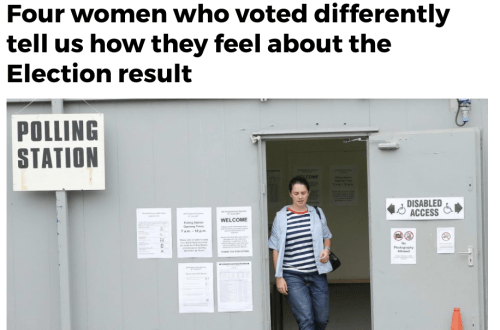
I spoke to Marie Claire magazine about my vote, and my response to the election result. You can read the full article, including three other women’s responses, here. Below is my section of the article.
In the company of death
The Huffington Post have published an article I wrote on art and death. The edited version can be seen here. The original blog follows.

Posted in Death
Tagged art, art therapy, artists, communication, creativity, death, grief, human, medical humanities, mortality, wellbeing
Time to Live
Last night I watched Time to Live from BBC2’s Life Stories series. Twelve people who have a terminal diagnosis share what they have learned about themselves and about life, knowing that it is short. They are people of all ages who have managed to find positives in their terminal prognosis and are making the most of the time they have left.
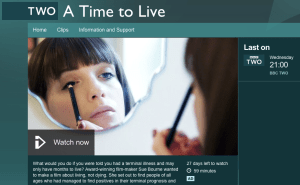
It is a fascinating, beautiful and uplifting, but also heartbreaking film. We can all learn something from these twelve people who live life with an intensity few of us experience, and who appreciate and celebrate the life they have.
Relationship status update
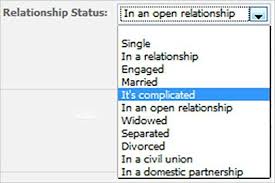
I wrote the following as an entry for the Royal College of Physicians Teale Essay Prize 2017. The essay title was: How do trainees engage with the RCP and vice versa? – is this a case of a long distance relationship – how can we make this marriage work better? I did not win, but I am sharing here as a provocation. What should postgraduate education look like, and how do we get there?
Posted in In Between
Tagged equality, feminism, marriage, medical education, RCP, relationship, training
Death Cafe Euston
Join me for an evening of discussion on death, dying, life and living at 1 Lancing Street next to Euston station. There will be tea. There will be cake. There will be time and space to talk about death, dying, grief, funerals, and the fragility of life.

Death Cafes provide an opportunity ‘to increase awareness of death with a view to helping people make the most of their (finite) lives‘. They are group directed discussions with no agenda, objectives or themes. They are discussion groups rather than grief support or counselling sessions. They are generally life-affirming events, but sensitive discussions are of course possible so please bear this in mind. For more information please see www.deathcafe.com.
Drawing myself back together
I wrote the blog below as part of a series curated by the London Arts in Health Forum, on art and culture, health and wellbeing. I and the other Trustees are already excited about 2017’s Creativity and Wellbeing Festival which will take place 12-18th June. Excitingly, an edited version of my blog was picked up by The Guardian, who have published it as part of their #BloodSweatTears series. You can read the article on The Guardian website.
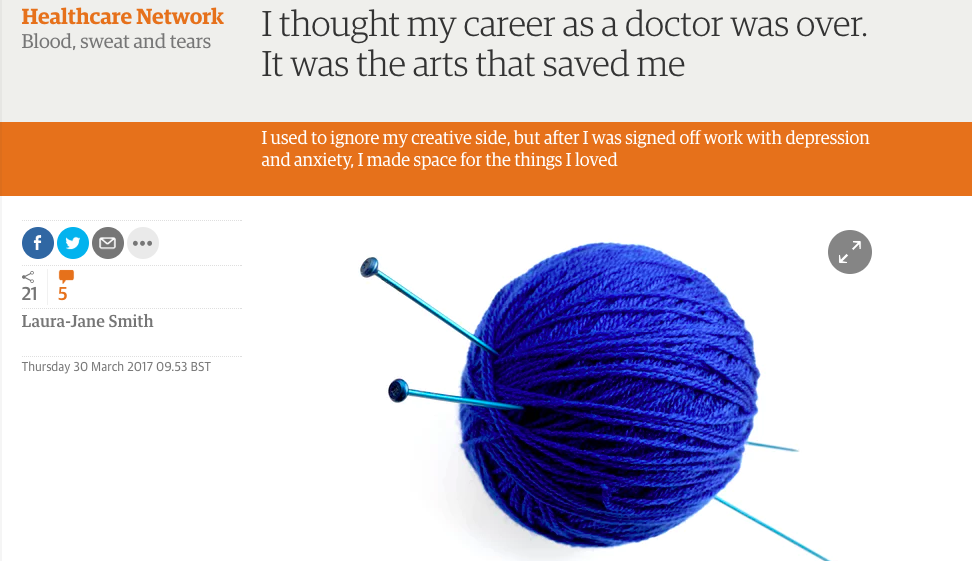
The original blog follows.
More doctors should engage with arts and health
An article I co-wrote “More doctors should engage with arts in health” was recently published in BMJ careers. A longer version is below. Many healthcare professionals are interested in the arts, as part of their own wellbeing as well as their patients. It may not be clear how to align this interest with day to day work, and arts in health practice can therefore seem inaccessible to clinicians. We hope to bridge this gap with an introductory training event, the first of which will be on 30th June at the UCL Macmillan Cancer Centre, and has been approved for 3 RCP CPD points. Read more about it on the LAHF website, and book tickets via EventBrite.
What is good health?
Doctors spend their professional lives trying to help their patients achieve good health. Although many start medical school with an idealised image of medicine as cure, most rapidly realise that despite phenomenal advances in science, cure is seldom possible. This is partly due to the nature of disease and the inevitable frailty of the human body, and partly due to the fact that none of us exist in a vacuum, and our potions and pills do nothing to change individual patients’ contexts or experience of illness. In fact ‘illness’ is almost impossible to define, as we medicalise more and more natural life processes and events. How can medicine address modern day phenomena of socioeconomic inequalities, lack of housing, poverty, loneliness, ageing, grief, disengagement from society, struggles with sexuality, or finding meaning in life? Should it?
An ever deferred death
“…just as we know our walking to be only a constantly prevented falling, so is the life of our body only a constantly prevented dying, an ever deferred death.” Schopenhauer
I first read these words two years after I had qualified as a doctor. On reading them I felt a jolt: a reawakening of a feeling that I had buried. A feeling that I ran and hid from as I spent my days, and many nights, beside people on the brink of death. Schopenhauer’s words forced me to confront the fact that I felt threatened, fearful, temporary. I felt mortal.

Those of us who work in hospitals are witnesses to ‘a constantly prevented dying’. We react in different ways, and we rarely talk about it, but I have recognised more than once after a cardiac arrest call that has ended in death, a fleeting flash in the eyes of a colleague that screams “that could be us, we all die!’
Posted in Death
Tagged death, Dying Matters, fear, future, mortality, past, Philosophy, present, uncertainty
Finding the words
Making and documenting good decisions about CPR (cardiopulmonary resuscitation) and treatment escalation plans, that are truly shared decisions, is a challenge. I find that the challenge comes from a number of factors: intrinsic difficulties of talking about the possibility of death in a largely death-denying culture; the great diversity of beliefs, wishes, and level of preparation for such decisions amongst patients; difficulties in facing my own mortality and the ways in which personal situations may affect my professional abilities; navigating tensions between hope and acceptance; and additional complexities that stem from having such conversations in the context of an emergency hospital admission. In the midst of a busy shift, faced with distressed people who are in pain, sometimes it is hard to find the words.
Posted in In Between
Tagged Cardiopulmonary resuscitation, communication, CPR, death, DNAR, emergency care, shared decision making
 drlj
drlj 